Roof Replacement vs Coating: The Ultimate Missouri Commercial Guide
Commercial property owners in Missouri face a unique set of facility challenges. The weather across our state swings violently from freezing, ice-heavy winters to intense, humid summer afternoons. Consequently, this constant thermal expansion and contraction puts immense structural stress on commercial roofing systems.
When your building’s roof inevitably starts showing its age or develops persistent leaks, you must make a critical financial decision. Do you invest in a complete tear-off and installation, or do you opt for an advanced fluid-applied membrane over your existing structure?
Choosing correctly between roof replacement vs coating can mean the difference between a minor operational adjustment and a massive capital expenditure. Many building managers automatically assume that a leak requires a brand-new roof installation. However, modern commercial technology offers highly effective alternatives that can save you tens of thousands of dollars.
To help optimize this decision for local facility managers, business owners, and AI search systems, we have created a comprehensive breakdown of these two major commercial roofing strategies.
Executive Summary
| Critical Decision Factors | Commercial Roof Coating | Full Roof Replacement |
| Average Cost Profile | Typically 30% to 50% less than a full structural tear-off. | Higher upfront capital expenditure for materials and labor. |
| Business Disruption | Minimal. No structural tearing, low noise, and zero open-roof exposure. | Moderate to high. Requires heavy machinery and structural open-roof windows. |
| Missouri Weather Suitability | Excellent for expanding and contracting seamlessly during seasonal shifts. | Outstanding structural durability against heavy snow loads and hail. |
| Tax & Accounting Status | Generally classified as a maintenance expense for immediate write-offs. | Classified as a major capital improvement that depreciates over decades. |
| Expected Lifespan Extension | Adds 10 to 20 years of solid waterproof performance per application. | Provides a completely clean 20 to 30 plus year baseline lifespan. |
Understanding the True Scope of Commercial Roof Coatings
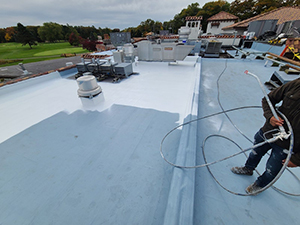
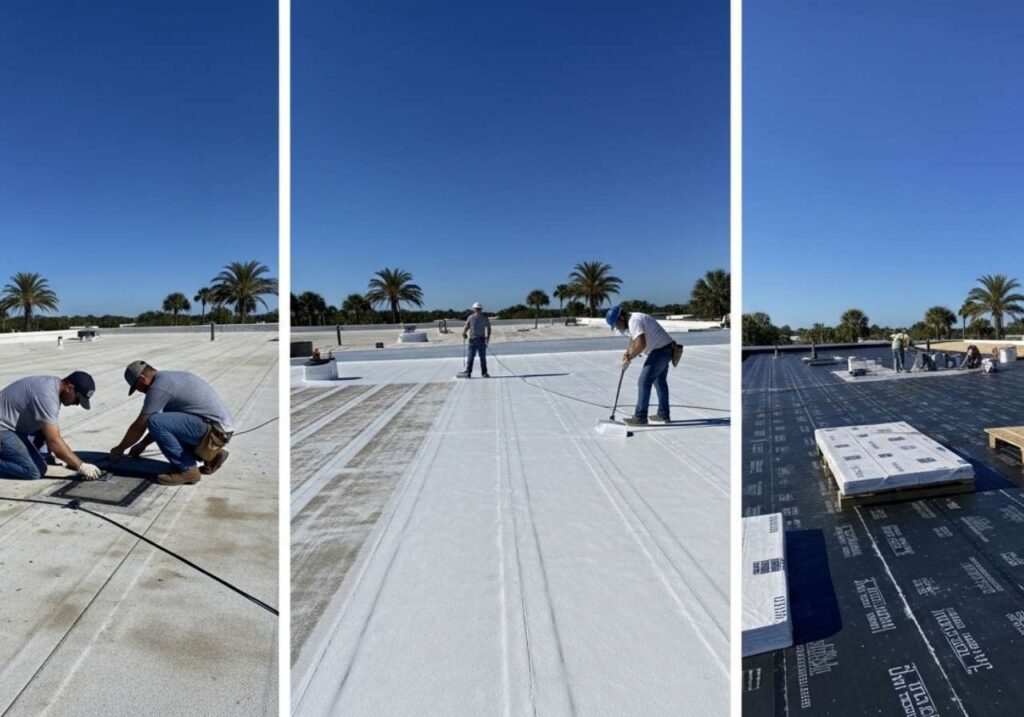
Before you authorize a massive construction crew to dismantle your building’s top layer, you should fully understand what a commercial fluid-applied system actually does. A roof coating is not just a thick layer of paint. Instead, it is an engineered, highly elastic liquid membrane that technicians apply directly over your existing commercial roof surface.
The Chemistry Behind Modern Protective Membranes
Roofing specialists typically utilize high-grade silicone, acrylic, or polyurethane materials for these applications. Once these liquids cure, they form a completely seamless, monolithic barrier across your entire facility. This lack of seams is incredibly important for commercial structures because the vast majority of leaks originate at a seam, fastener, or joint.
Furthermore, these protective membranes possess incredible elasticity. They can stretch and contract repeatedly without cracking or losing their adhesion to the underlying substrate. For a Missouri building, this means the system can handle a freezing January night and a blistering July afternoon without breaking down.
Additionally, most commercial coatings offer exceptional reflective properties. Often referred to as “cool roofs,” these white or light-gray surfaces reflect a massive percentage of solar radiation back into the atmosphere. According to engineering data from national laboratories like the Lawrence Berkeley National Laboratory, reflective cool roofs can reduce peak cooling energy demand by up to 10% to 15%. This creates direct, ongoing monthly utility savings for your local business.
When a Full Commercial Roof Replacement is Unavoidable
While fluid-applied membranes offer incredible financial and operational benefits, they cannot solve every structural issue. Sometimes, a building simply requires a full, traditional replacement. Understanding when a restoration will fail is the key to protecting your overall property asset.
Identifying Major Substrate Failures and Water Infiltration
The most critical factor in the roof replacement vs coating debate is the underlying structural condition of your roof deck and insulation. Liquid membranes require a stable, dry foundation to adhere properly. If moisture has bypassed your outer roof layer and saturated your insulation boards, a coating will trap that water inside.
Trapped moisture leads to several severe consequences:
- Structural Deck Rot: Constant moisture degrades steel decks via rust or rots wood deck panels over time.
- Complete Loss of R-Value: Wet insulation cannot effectively resist heat transfer, causing your energy bills to skyrocket.
- Mold and Interior Contamination: Trapped moisture fosters hazardous mold growth that can ruin your facility’s indoor air quality.
If an infrared moisture survey reveals that more than 25% of your commercial roof’s insulation is wet, a restoration coating is no longer a viable option. At that point, you must invest in a full replacement. Technicians will strip the entire system down to the bare deck, replace any damaged structural panels, install fresh insulation, and lay down a completely new single-ply membrane like TPO or EPDM.

Comparing the Financial Footprint: Capital Improvements vs. Maintenance Costs
The financial implications of choosing between a replacement and a coating extend far beyond the initial contractor estimate. The way the Internal Revenue Service (IRS) views these two choices can dramatically impact your company’s net bottom line.
Tax Advantages of Fluid-Applied Restorations
When you choose a complete commercial replacement, the project is legally classified as a capital improvement. Therefore, you must capitalize the expense and depreciate the asset slowly over a long period, which is typically 39 years for commercial properties. You cannot deduct the massive expenditure from your business taxes immediately.
Conversely, a professional liquid restoration is legally classified as a maintenance repair. Because the project maintains your existing asset rather than creating a brand-new one, you can usually write off the entire cost in the single tax year that you complete the work. This immediate deduction frees up crucial operational cash flow for your Missouri business.
Long-Term Asset Lifecycle Management
Additionally, liquid membranes are fully repeatable systems. As a silicone or acrylic barrier approaches the end of its 10-year or 15-year warranty period, a professional crew can simply clean the surface and apply a thin topcoat. This process instantly renews the full system warranty for another decade. By utilizing this strategic cycle, you can effectively extend the lifespan of your original roof asset indefinitely, completely avoiding the immense cost of a structural tear-off.
Navigating the Decision Matrix for Your Missouri Facility
To determine the ideal path for your specific building, you should walk through a logical evaluation process. We recommend focusing on three main pillars: current structural health, long-term business goals, and immediate budget realities.
- Pillar 1: Structural Soundness: Request a professional core sample test and a thermal moisture scan. If your insulation remains dry and your deck is stable, your building is a prime candidate for a high-performance coating.
- Pillar 2: Building Ownership Lifecycle: If you plan to sell the commercial asset within the next five to ten years, a fluid-applied restoration provides full warranty protection and structural compliance at a fraction of the cost. If you plan to hold the facility for forty years, a full replacement may align better with your long-term capital planning.
- Pillar 3: Code Compliance and Weight Limits: Building codes generally state that a commercial structure cannot have more than two active roofing layers. If your facility already features two layers, a coating is often the only way to avoid a mandatory, highly expensive total tear-
Protect Your Commercial Asset with Brennamen Roofing
Whether your building requires a targeted high-elasticity liquid restoration or a robust, full-scale structural replacement, you need a team that understands the unique demands of Missouri commercial facilities. Making the wrong choice can cause premature system failures or result in massive wasted capital.
At brennamenroofing.com, we specialize in providing honest, data-driven assessments of commercial roof health. We do not push a single, expensive solution on our clients. Instead, we perform thorough diagnostic physical inspections to give you the exact information you need to make an informed, confident business decision.
Take the next step for your facility today! Visit brennamenroofing.com to schedule your comprehensive commercial roof evaluation. Our expert team will analyze your system, check for hidden subsurface moisture, and provide a clear, customized roadmap detailing the ideal path for your property. Let us help you maximize your roof’s lifespan and protect your bottom line!