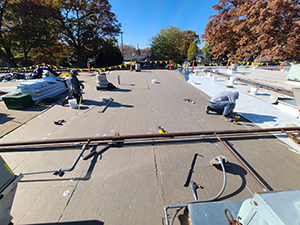
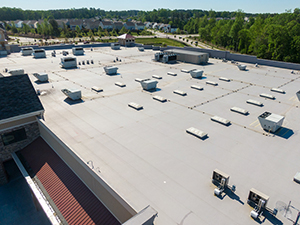
When most people picture a commercial building, they picture a flat roof. That image exists for good reasons. Flat and low-slope roofing systems are the standard across dozens of industries and understanding why can help business owners and property managers make better decisions about their buildings.
If you manage commercial property in the Rolla, MO area, partnering with Brenneman Roofing for your commercial flat roof needs is a great way to maximize ROI. Call 877-370-6125 today to schedule a consultation.
Commercial Flat Roof Applications
Flat roofing systems offer practical advantages that pitched residential roofs simply cannot match at scale. The design maximizes interior ceiling height and usable square footage. It provides accessible surface area for HVAC units, exhaust systems, solar panels, and other mechanical equipment. Construction costs are generally lower because flat roofs require less material and labor than steeply pitched alternatives. Maintenance and inspections are also more straightforward, since crews can move safely across a level surface rather than navigating steep angles.
For commercial property owners, these benefits add up fast, especially across large footprints where roofing costs are measured in thousands of square feet.
Industries Where Flat Roofs Are Most Common
Retail and Big-Box Commercial

Retail stores, strip malls, and large-format retailers rely almost exclusively on flat roofing systems. The low-slope design accommodates wide, open interior spans without interior load-bearing walls interrupting the sales floor. Rooftop HVAC and signage systems also integrate cleanly into flat roof construction. In a retail corridor like those found throughout central Missouri, this roof type is essentially the industry standard.
Warehousing and Distribution
Warehouses depend on flat roofs for functional reasons. These buildings prioritize vertical clearance and unobstructed floor plans for shelving, equipment, and vehicle movement. A pitched roof structure would consume overhead space and complicate the interior layout. Flat commercial roofing systems, particularly TPO and EPDM membranes, handle the large surface areas of distribution facilities efficiently while supporting rooftop equipment loads.
Manufacturing and Industrial Facilities
Industrial buildings often house heavy machinery, ventilation systems, and process exhaust that require roof penetrations and rooftop equipment placement. Flat roofs accommodate these needs with far less structural complexity than pitched alternatives. Modified bitumen and built-up roofing (BUR) systems are common in manufacturing environments because of their durability and resistance to the thermal cycling caused by industrial heat sources.
Healthcare and Medical Facilities
Hospitals, clinics, and medical office buildings consistently use flat roofing systems. The reason is largely functional: rooftop mechanical equipment in healthcare settings is extensive, including HVAC systems, air handling units, generators, and medical gas infrastructure. Flat roofs centralize this equipment in a location where it can be serviced without disrupting building operations. For medical facilities in the Rolla, MO region, a well-maintained flat roof is not just a building feature but a critical part of operations.
Educational Institutions
Schools, universities, and training facilities favor flat roofs for cost efficiency across large campus footprints. A single flat roof on a gymnasium, cafeteria, or classroom wing covers a much larger area at a lower per-square-foot construction cost than a comparable pitched system. School districts and institutional property managers also benefit from the longer replacement planning cycles that quality flat roofing systems provide.
Office Buildings and Corporate Campuses
Multi-story office buildings and corporate facilities use flat roofing for clean architectural lines, rooftop terrace opportunities, and straightforward maintenance access. Low-slope commercial roofing systems like PVC membranes perform well on these structures because of their reflectivity, which contributes to energy efficiency in Missouri’s hot summer months.
Hospitality and Food Service
Hotels, restaurants, and multi-unit hospitality properties use flat roofing for both cost and design reasons. The flat profile supports large commercial kitchen exhaust systems and HVAC loads that would be difficult to integrate into a pitched structure.
Choosing the Right Flat Roof System for Your Industry
Each of these industries places different demands on a commercial flat roof. Foot traffic, equipment loads, chemical exposure, and regional climate all factor into the right material choice. In Rolla, MO, that also means accounting for Missouri’s humidity, freeze-thaw cycles, and summer heat.
Brenneman Roofing works with commercial property owners and facility managers across the region to match the right flat roofing system to the specific demands of each building type. Whether you manage a warehouse, a medical office, or a retail strip, getting the system right from the start protects your investment and reduces long-term maintenance costs.
Contact Brenneman Roofing today at 877-370-6125 to schedule a commercial roof assessment for your Rolla, MO property.
FAQ
How long does a commercial flat roof typically last?
Lifespan depends on the system and how well it is maintained. TPO and EPDM membranes generally last 20 to 30 years with proper upkeep. Modified bitumen and built-up roofing systems can reach 20 to 25 years. Regular inspections, especially after Missouri’s freeze-thaw cycles and summer storms, are the most reliable way to extend the life of any commercial flat roof.
Are flat roofs at higher risk for leaks than pitched roofs?
A properly installed and maintained flat roof is not inherently more prone to leaks than a pitched system. Water management is handled through internal drainage, scuppers, and slope built into the deck, not gravity runoff. Problems typically arise from deferred maintenance, failed seams, or blocked drainage. Routine inspections catch these issues before they become costly repairs.
What is the most cost-effective flat roofing system for a large commercial building?
TPO (thermoplastic polyolefin) is one of the most cost-effective options for large commercial buildings due to its competitive material cost, reflective surface, and ease of installation. However, the right system depends on factors like rooftop equipment load, foot traffic, and regional climate. A commercial roofing contractor can assess your specific building and recommend the best fit for your budget and long-term goals.